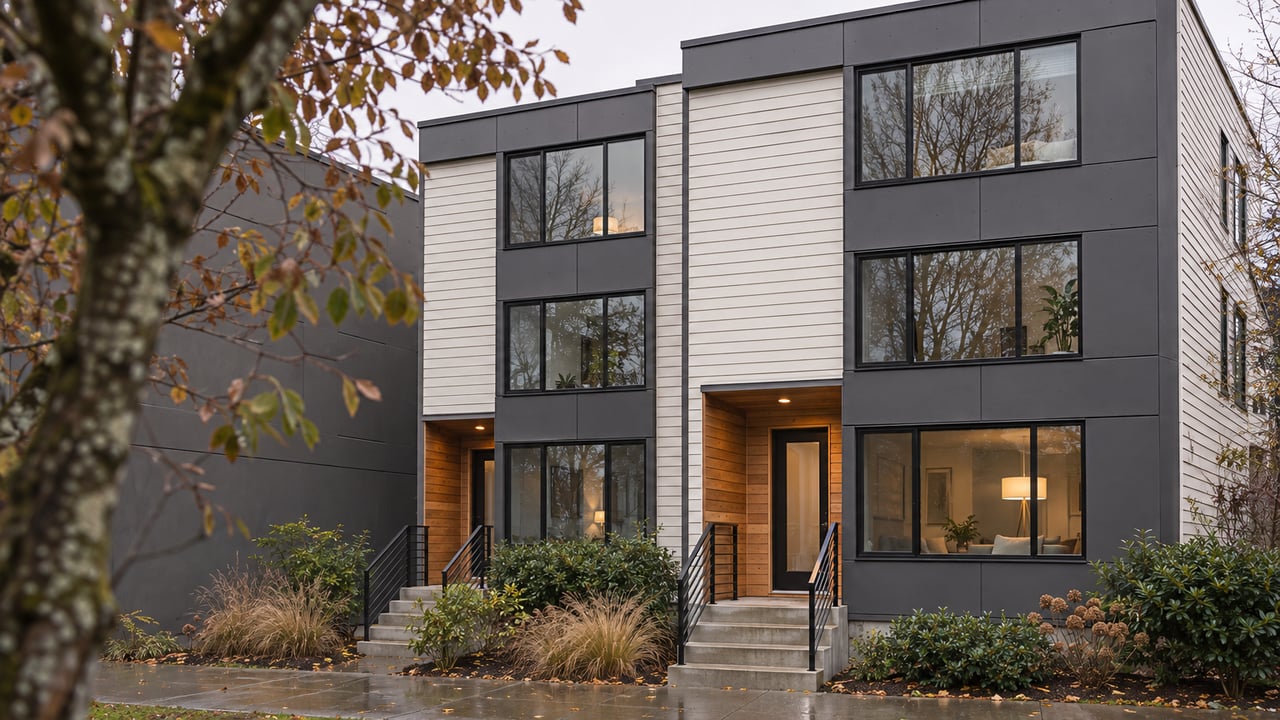
At the upper entrance to Judkins Park Station on 23rd Avenue South, riders step off the platform a short walk from two parks, a museum and a network of bike paths. That is how The Seattle Times described it a week before opening day. The streets around that entrance are mostly lined with townhouses. According to The Urbanist, townhomes are the predominant housing type by the station's eastern exit, and more than 600 of them have been built within a 15-minute walk.
For anyone working in Bellevue or Redmond and weighing a home on the Seattle side of the lake, this station area is new. The 2 Line began carrying passengers across Lake Washington on March 28, 2026, and the first train left Judkins Park at 10:27 that morning, the Seattle Times reported. Nearly eight months later, the listings around the station advertise the train. The prices do not yet show it. Recent townhouse sales here still follow the age and finish of the building, which means a buyer this fall is paying for the house and getting the station walk without an added premium.
What the train actually connects
Seattle Transit Blog's estimate puts International District/Chinatown 22 minutes from Bellevue Downtown station and 41 minutes from Downtown Redmond. It also notes that times vary by direction and at peak hours. Judkins Park is the next stop east of International District/Chinatown, so the ride from Judkins Park to downtown Bellevue is a little shorter than that 22-minute figure. On Sound Transit's regular 2 Line schedule, trains run every 8 minutes at weekday peaks and every 10 minutes on weekends until 10 p.m. A Microsoft or downtown Bellevue commute can now start with a walk to a platform rather than a drive onto I-90. Weekend maintenance sometimes swaps trains for shuttle buses between International District/Chinatown and South Bellevue, so the 2 Line page is worth checking before a weekend trip.
How long a resident's door-to-platform walk takes depends on which side of the station they live on. The same Seattle Times piece called Judkins Park "a tale of two stations." It described the 23rd Avenue South entrance as the pleasant one and the lower entrance on Rainier Avenue South as sitting under the I-90 ramps. The Urbanist adds that riders using the western exit cross the tracks at a gated, at-grade crossing on the way to the platform. Work is planned on the Rainier side. The ramps would be reconfigured with traffic signals and better crosswalks, and more frequent bus service would arrive. For now, the townhouse blocks by the 23rd Avenue entrance have the easier walk to the platform.
Two kinds of housing around one station
The homes around Judkins Park fall into two groups. According to The Urbanist, midrise buildings line the Rainier Avenue corridor and townhomes fill the blocks around them. 900 Rainier was completed in 2025 with 396 homes, 110 of them income-restricted. Grand Street Commons was completed in 2024 and has three mixed-use buildings with 771 homes, 361 of them income-restricted, and more than 60,000 square feet of commercial space. For a buyer who wants a front door of their own near the station, the choices are mostly townhouses. The largest townhouse project is Joya Townhomes Condominium, with 62 homes and a retail space, completed in 2023.
Construction is still underway. The Urbanist counts more than 2,000 homes built around the station since 2018 and about 900 more in the pipeline. The pipeline includes 96 homes at 2029 24th Avenue South, 203 at 1906 20th Avenue South and 58 at 2007 South State Street. A townhouse bought here now will share the walk to the platform with several hundred more households over the next few years.
The station shows up in the listings, not the prices
Sellers have noticed the train. A 2011 townhome on 25th Avenue South was marketed as under a 10-minute walk from Judkins Park Station. A townhouse on 20th Place South was listed in mid-November at $799,000 for 1,760 square feet, about $454 a square foot, and its listing also names the station.
The sale prices tell a different story. In August 2026, the 25th Avenue South townhome closed at $549,000 for 1,392 square feet, about $394 a square foot, after 15 days active. That same month, a newly built townhouse-style condo at Leschi Haus on 32nd Avenue South closed at $815,000 for 1,125 square feet, about $724 a square foot. The home with the shorter walk to the train sold for roughly half as much per square foot as the new build in Leschi, which sits farther east toward the lake. Two sales do not make a price index. Still, the gap runs in the direction of age and finish, not distance to the platform.
The zip codes around the station show a wide middle as well. In a market snapshot dated November 9, 2026, covering sales tracked over the prior six months, 98144 had a median sold price of $799,950, and the middle half of sales ran from about $625,000 to $1.07 million. 98122 had a median sold price of $869,000 over the same six months. Those figures cover every home type in the zip codes, not townhouses alone. Even so, a range that wide in a small area points to a market still sorting homes by the building itself.
Where a buyer has room this fall
Seattle's citywide numbers explain why sellers of new townhouses are offering terms. In The Madrona Group's report for October 2026, new construction across Seattle had 682 active listings. Pending sales were down 25.0% from a year earlier and closings were down 45.1%. Homes averaged 38 days to an offer, and the segment held 5.4 months of supply based on contracts. Resale houses and townhomes in the same October report had 3.3 months of supply. These are citywide figures, but they describe the market that a builder near Judkins Park is competing in.
The terms show up on individual listings. The Leschi Haus listing was marketed with a preferred-lender rate buydown, a closing-cost credit and no fees on a future refinance. A newer townhouse on 17th Avenue in 98122, about a mile north of the station, was listed in early June at $949,950. Its price was cut to $924,950 in August, to $899,900 in September and to $874,950 in late October, and the listing advertises a $40,000 buyer credit. As of mid-November it had been on the market 132 days.
This is the opening for an Eastside worker considering the Seattle side. New townhouses near the station compete with a citywide new-construction inventory that is moving slowly, and builders are paying for that with credits and rate help. A buyer who negotiates on the building's age, finish and terms is paying for what the comparable sales are paying for, and the train to Bellevue runs every 8 minutes at weekday peaks either way.
Questions we hear about Judkins Park
Does living by the 23rd Avenue entrance make a real difference? For a daily commute, it changes the walk. The Seattle Times described the 23rd Avenue South entrance as steps from parks, a museum and bike paths, and the Rainier Avenue entrance as sitting under the I-90 ramps. The Urbanist reports that townhomes are the predominant housing type on the eastern side, so most for-sale homes in the station area are on the easier side.
Will more construction near the station hold prices down? The Urbanist counts about 900 homes in the pipeline around the station, with the largest projects planned as multifamily buildings. Most of those are larger buildings, not townhouses. The bigger factor for a townhouse buyer this fall is the citywide new-construction inventory and the builder credits that come with it.
How does this compare with buying near a 2 Line station on the Eastside? That depends on the station and the property type. Our Bellevue and Redmond pages cover the Eastside end of the line, and our Seattle neighborhood page covers the west side of the lake. If your commute ends at a Microsoft campus, see our Microsoft Advantage page.
If a townhouse near Judkins Park Station is on your list, Macdonald Group would be glad to go over the recent sales with you, set a new build's credits beside a resale's price, and talk through which side of the station fits your commute. You can start with our buyer services, or get in touch whenever you are ready.