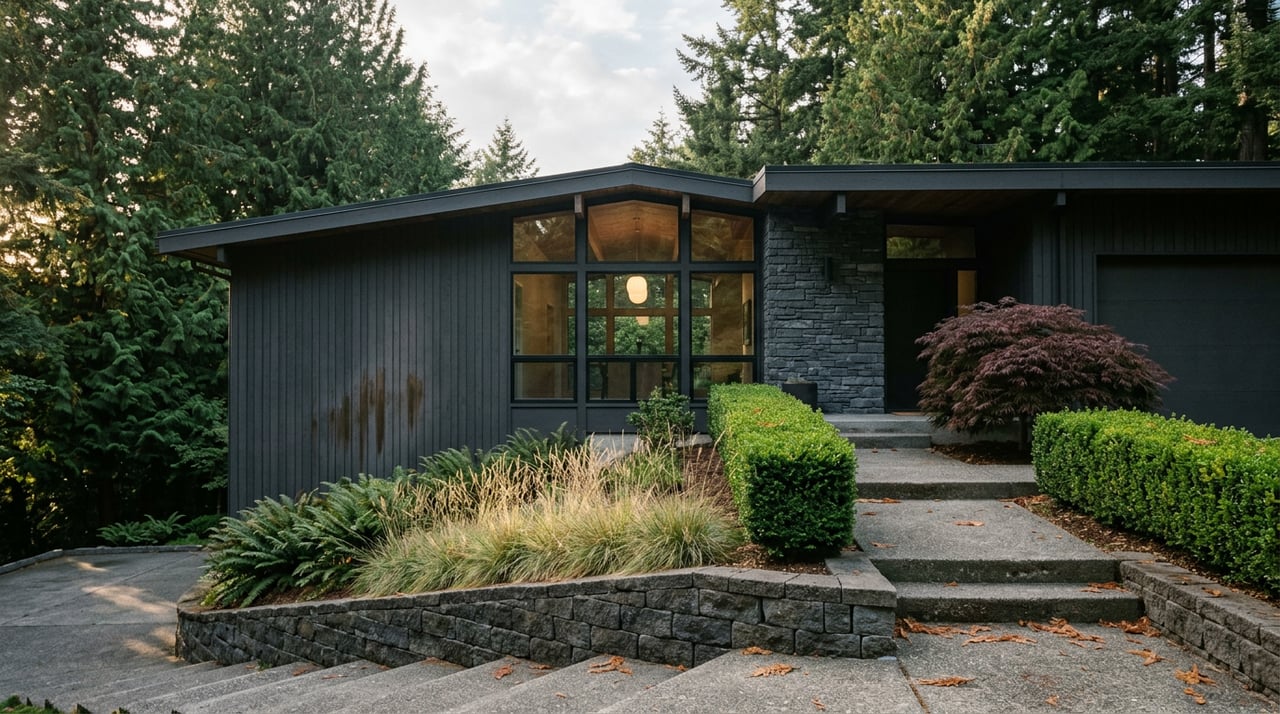
A three-bedroom rambler in Education Hill sat on the market for six weeks this summer before its owners cut the price. Half a mile from the Redmond Technology Station, a two-bedroom condo went pending in under ten days with multiple offers. Both are technically in Redmond. Both would show up under the same citywide median price if you searched a portal for "Redmond home values." That number would tell you almost nothing useful about either one.
Redmond's housing market isn't one market wearing a single zip code. It's two, and they're moving in opposite directions at the same time.
The Number That Blends Two Different Cities
Ask five sources what a home costs in Redmond right now and you'll get five different answers, not because anyone's data is wrong, but because they're each averaging together neighborhoods that don't behave alike. As of July 2026, Zillow's home value index for the city sat at roughly $1.35 million, down about 4 percent from a year earlier. Redfin's three-month trailing figure through June 2026 put the median sale closer to $1.3 million, down a fraction of a percent year over year, with a median price per square foot of $620.
Those numbers are accurate. They're also an average of two submarkets that a buyer or seller should never treat as interchangeable: the Overlake corridor around Microsoft's campus and the Redmond Technology Station, and everything else, meaning Education Hill, Grass Lawn, North Redmond, and the older single-family pockets that make up most of the city's land area.
One of those submarkets is still tight. The other has loosened considerably. Blend them together and you get a citywide figure that describes the average of two extremes rather than the reality of either.
What the Split Actually Looks Like
| Overlake / 98052 corridor | Education Hill, Grass Lawn & North Redmond | |
|---|---|---|
| Median sold price | Roughly $1.64 million as of May 2026 | Broadly $900K to $1.6M+, depending on vintage and lot |
| Inventory trend | Tight, still favors quick decisions | Up an estimated 67.8% year over year as of a June 2026 read of NWMLS-reported figures |
| Recent price cuts | Uncommon | About one in three listings (32.2%) cut price in the trailing 30 days |
| Primary demand driver | Microsoft campus proximity, light rail access | LWSD school assignment, lot size, established neighborhoods |
| What buyers are actually competing for | New transit-adjacent condos and townhomes, or older 1960s-80s single-family lots with redevelopment potential | Negotiating room on 1970s-90s housing stock that often needs updating |
The gap in inventory growth alone explains most of the confusion. A citywide "months of supply" figure that averages a near-empty Overlake with a rebuilding Education Hill produces a number that doesn't match what either buyer actually experiences on a Saturday afternoon of touring.
Why Overlake Won't Cool Down
Overlake's tightness isn't a mystery once you look at what's happening on the ground. Microsoft's campus expansion there is a $5 billion project, and as of April 2026 twelve of the planned seventeen buildings were complete. That's thousands of jobs added within walking distance of the neighborhood, not thousands of jobs somewhere else in the region.
Redmond Technology Station, formerly known as Overlake Transit Center, opened as a light rail stop on the 2 Line in April 2024, and the Downtown Redmond Link Extension carried that line further into the city in 2025. For the first time, someone working at Microsoft's campus can live car-light and still reach downtown Seattle or Bellevue without fighting SR-520 traffic. Microsoft's return-to-office policy, which took effect in 2026 and requires employees within 50 miles of campus to be in the office at least three days a week, has pushed a wave of relocation demand back toward exactly this corridor, reversing years of remote-work dispersal to Texas, California, and beyond.
Institutional capital is betting the same way. The Overlake Seritage site, a 6.9-acre parcel near the campus with an already-approved development agreement and more than $21 million in infrastructure invested, went to market in early 2026 specifically because brokers see sustained demand for housing near this stretch of transit and employment. That's not speculation about the future. That's money moving now because the near-term case is already strong.
Buyers looking at Overlake should understand they're choosing between two very different products within the same neighborhood. Behind the newer condo and townhome buildings clustered near the station sits an older layer of 1960s-80s single-family homes and garden-style condo complexes, often on larger lots than the new construction offers. The newer product sells you a finished commute today. The older product sells you square footage and land value, with the neighborhood's future built into the price rather than delivered on closing day. Neither is wrong. They're different bets, and a buyer should know which one they're making.
The Rest of Redmond Is a Different Conversation
Move a few miles from the Microsoft campus and the market reads almost like a different city. Education Hill, Grass Lawn, and North Redmond have all seen inventory build through 2026, and sellers who priced as if it were still 2023 are the ones now sitting through price reductions.
Education Hill's housing stock explains part of why. The neighborhood is a genuine mix of 1970s split-levels, 1990s two-story homes, and scattered newer construction, often within blocks of each other, which means condition and lot quality drive price far more than location within the neighborhood does. Most addresses here feed into Einstein Elementary, Redmond Middle School, and Redmond High School, all part of the Lake Washington School District, and the neighborhood backs up to Farrel-McWhirter Park, a 68-acre space with trails and farm animals that gives it a rural feel despite sitting two miles from downtown.
Grass Lawn is quieter still, built mostly around Grass Lawn Park as its gathering point, with lower-density housing and a handful of apartments and condos near the main corridors. North Redmond offers the widest floor plans for the money of any established Redmond neighborhood, still zoned into LWSD, still within a reasonable drive of the Microsoft campus, but without the price premium that comes with an Education Hill address.
For a buyer, this means real leverage that didn't exist two years ago. A 5 percent overreach on price no longer produces a bidding war here. It produces weeks on market, followed by a reduction conversation, followed by a final sale price that often lands below what accurate pricing would have achieved from the start. That dynamic cuts both ways. It's leverage for a patient buyer and a pricing discipline problem for a seller who hasn't updated their expectations since the last frenzy.
A Caution About Downtown Redmond's Own Numbers
Downtown Redmond deserves a brief note of its own, separate from the two-market split above, because its recently reported statistics are easy to misread. Through the three months ending June 2026, the neighborhood's median price per square foot appeared to drop over 40 percent year over year. That sounds dramatic until you notice the sample size: only six homes closed there in June 2026, compared to thirteen a year earlier. A handful of closings, weighted toward a different mix of condos versus single-family homes than the prior year, can move a percentage like that without reflecting any real shift in value. Downtown Redmond is walkable, sits along the Sammamish River Trail, and continues to add restaurants and retail, but its month-to-month statistics are too thin to draw a trend from. Treat any single month's numbers there as a data point, not a verdict.
What This Means If You're Comparing Neighborhoods
If certainty about appreciation and a short commute to Microsoft matter most, Overlake is where to concentrate a search, with a clear-eyed choice between new construction near the station and older stock that's really a bet on the neighborhood's next decade. If negotiating room, larger lots, and established tree canopy matter more than proximity to campus, Education Hill, Grass Lawn, and North Redmond currently offer more room to work with than they have in several years. A buyer who searches "Redmond" as a single market and compares every listing against one blended median will misjudge both ends of that range.
Is Redmond a buyer's market or a seller's market right now? Both, depending on which part of the city you mean. Overlake still favors sellers. Education Hill, Grass Lawn, and North Redmond have shifted enough that buyers have real room to negotiate.
Does a new light rail station guarantee a neighborhood's home values will keep climbing? Not automatically. Overlake's demand is backed by an anchor employer expanding its physical footprint, not just a train stop. A station without that kind of employment base behind it is a different, less certain bet.
Should I wait for prices to soften further in Education Hill or North Redmond? That depends on your timeline and what you're comparing it against elsewhere on the Eastside. The trend as of mid-2026 favors buyers there more than it has in years, but trends can turn on inventory and rate movement that no one can predict with precision.
Numbers like these change month to month, and the difference between a citywide average and a neighborhood-specific read can be the difference between a good offer and an overpriced one. If you're weighing Overlake against Education Hill, or trying to figure out which Redmond submarket actually fits your budget and timeline, Macdonald Group can walk you through the current numbers block by block before you write an offer. Get in Touch.